Make a Prediction
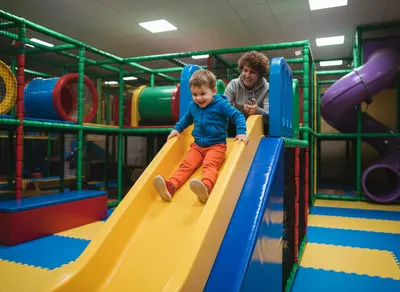
Gather items you can roll down a slide. Balls, toy cars, pencils, small stones.
Look at the items you've gathered and make a guess about what will reach the bottom first. Scientists call this guess a hypothesis. Scientists always start their experiments by writing down their hypothesis. You can write or draw a picture of what you think will roll the fastest in your notebook.
Make a results table.
To make observations like a real scientist, start by making a results table in your notebook. Draw two columns on a piece of paper, then write or draw a picture of each of the objects you will roll down the slide.
Time and Record Your Observations
Place one of your objects at the top of the slide and let it go. Start your stopwatch at the same time. Stop the stopwatch when it reaches the bottom. Write down how fast it slid down the slide.
Extra credit for older kids: Sometimes, subtle changes in how we drop the ball, the height we drop it from, or how quickly we click the stop watch buttons can change our results dramatically. Real scientists rarely do just one experiment. They try to do lots and lots of experiments to make sure they get consistent results. Instead of rolling your object one time, try rolling it 10 times. When comparing how fast one object rolled to another, compare the average time each object took. The more attempts you put into your average, the more accurate your experiment will be.
Compare Results
Notice the differences in speed. Did your prediction match what actually happened? Some objects roll faster because they are smoother, lighter, or shaped differently. Why do you think this object rolled the fastest? This guess will become your new hypothesis to test.
Test your new hypothesis
Test your new hypothesis by rolling your objects from different heights or using a different technique to drop them.
For example, if your new hypothesis is that light objects roll fastest, do all of the light objects still roll the fastest if you roll them down a taller slide?
Understanding your results
The results of this experiment are caused by two forces of nature called Gravity and Friction.
Gravity is an invisible force that pulls things together. Large objects, like the earth, pull small objects like your ball, really hard towards them. Gravity is why your objects will always move towards the ground when you drop them instead of floating through the air.
When two objects rub against each other, that causes friction. Friction is created between the wheels of a toy car and the slide as it rolls down. The more friction between two objects, the slower they will move past each other. Through lots of experiments, scientists have learned that smooth, round, and greasy items all have less friction, so they will typically roll faster than rough, sticky, or bumpy items.
Did your observations match what a scientist would have expected? If not, maybe you need to do try again!